Cubism & Early Abstraction · 1920
Angelus Novus
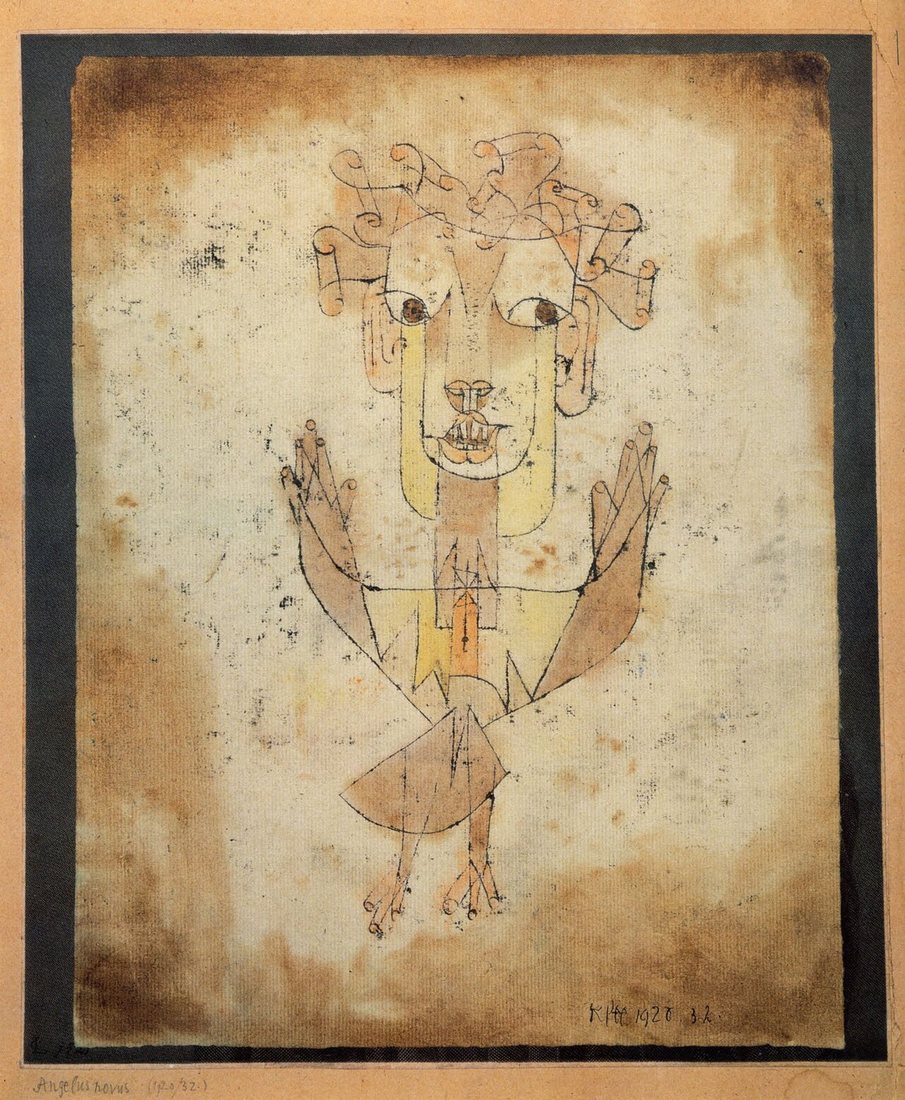
Angelus Novus (1920) by Paul Klee. Its palette is led by pale sand (#d3c29e, 42%) and light amber (#bf9868, 32%), with accents of rich scarlet brown and soot. Overall the canvas is light, moderately saturated and warm.
Color note
After a trip to Tunisia in 1914, Klee wrote in his diary: “Color and I are one. I am a painter.” He later taught color theory at the Bauhaus.
Palette
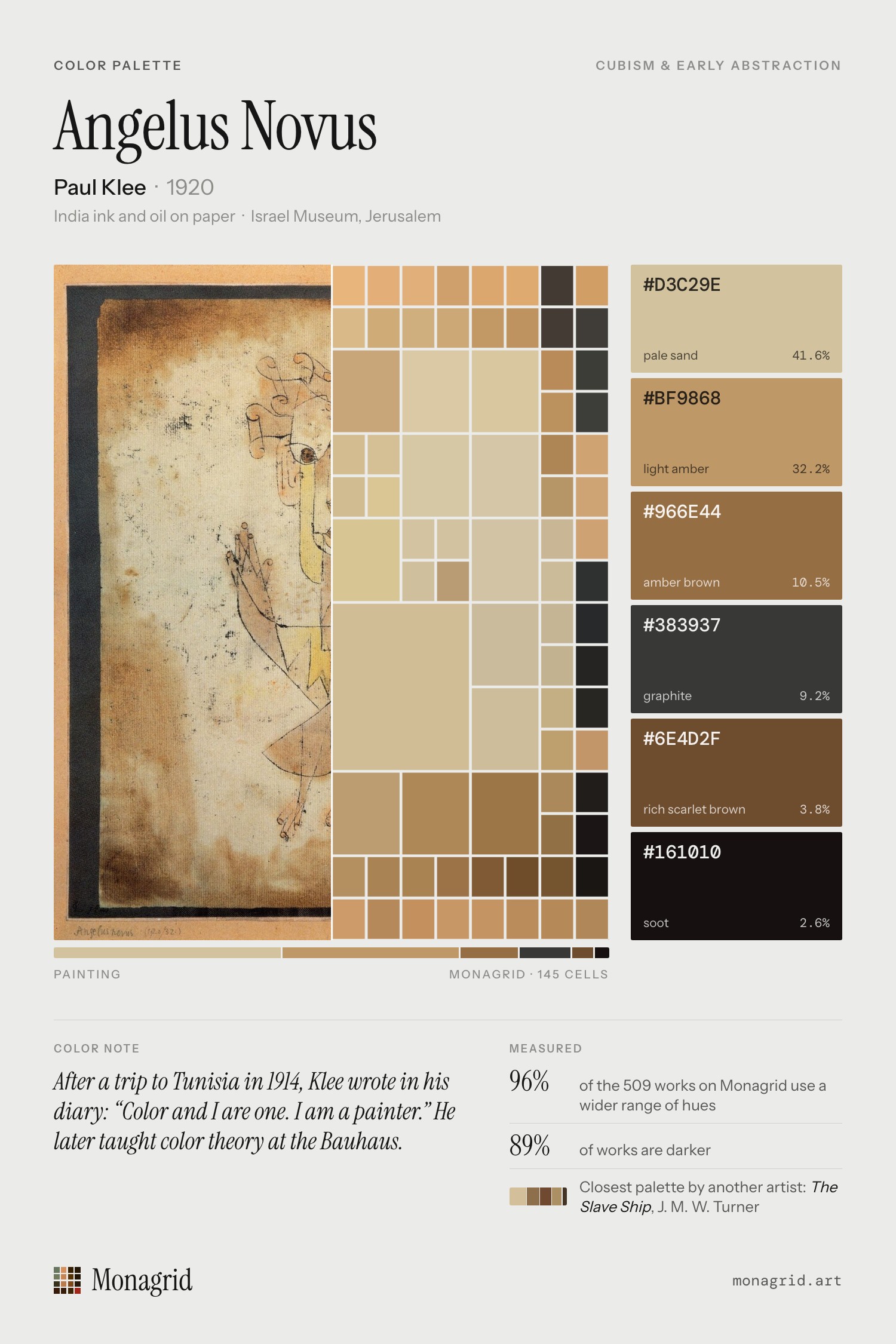
- #d3c29e MG 180 pale sand 41.6% of canvas
- #bf9868 MG 033 light amber 32.2% of canvas
- #966e44 MG 166 amber brown 10.5% of canvas
- #383937 MG 218 graphite 9.2% of canvas
- #6e4d2f MG 162 rich scarlet brown 3.8% of canvas
- #161010 MG 223 soot 2.6% of canvas
Color families
Brown 57%, Yellow 17%, Orange 12%, Gray 6%, Black 4%
Measurements
Composition
51% of the visual weight is in the left half, 55% in the lower half. Symmetry 0.76 (how closely its shapes and edges mirror each other). 36% of the canvas is calm space. Half of the detail sits in 33% of the canvas. Measured from the image, not a rule the painter followed.
Details
Share
Download the pin · Save to Pinterest

More by Paul Klee
- Sumpflegende, 1919
- Villa R, 1919
- Senecio, 1922
- Twittering Machine, 1922