Cubism & Early Abstraction · 1913
Composition VII
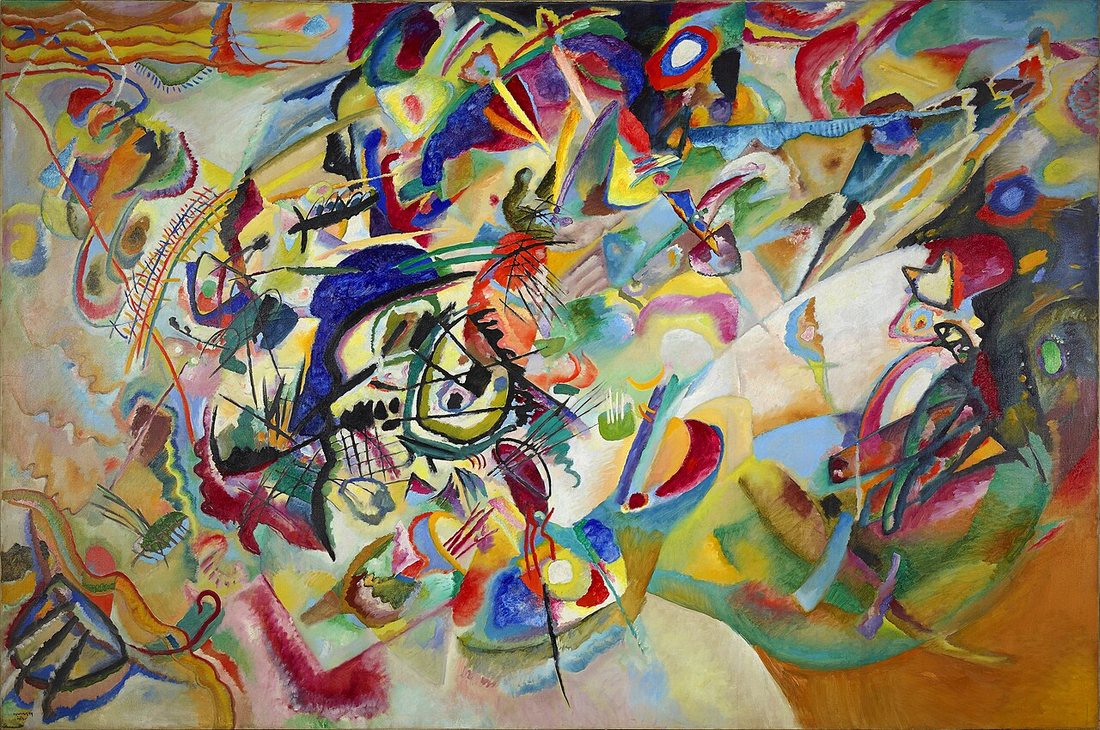
Composition VII (1913) by Wassily Kandinsky. Its palette is led by light golden sand (#ada68e, 29%) and muted lime green (#70835d, 19%), with accents of taupe, dark crimson, charcoal and dark indigo blue. Overall the canvas is light, vivid and warm.
Color note
Kandinsky tied colors to sounds and emotions: in Concerning the Spiritual in Art (1911) he likens yellow to a blaring trumpet and deep blue to a pull toward the spiritual. He later taught color and form at the Bauhaus.
Palette
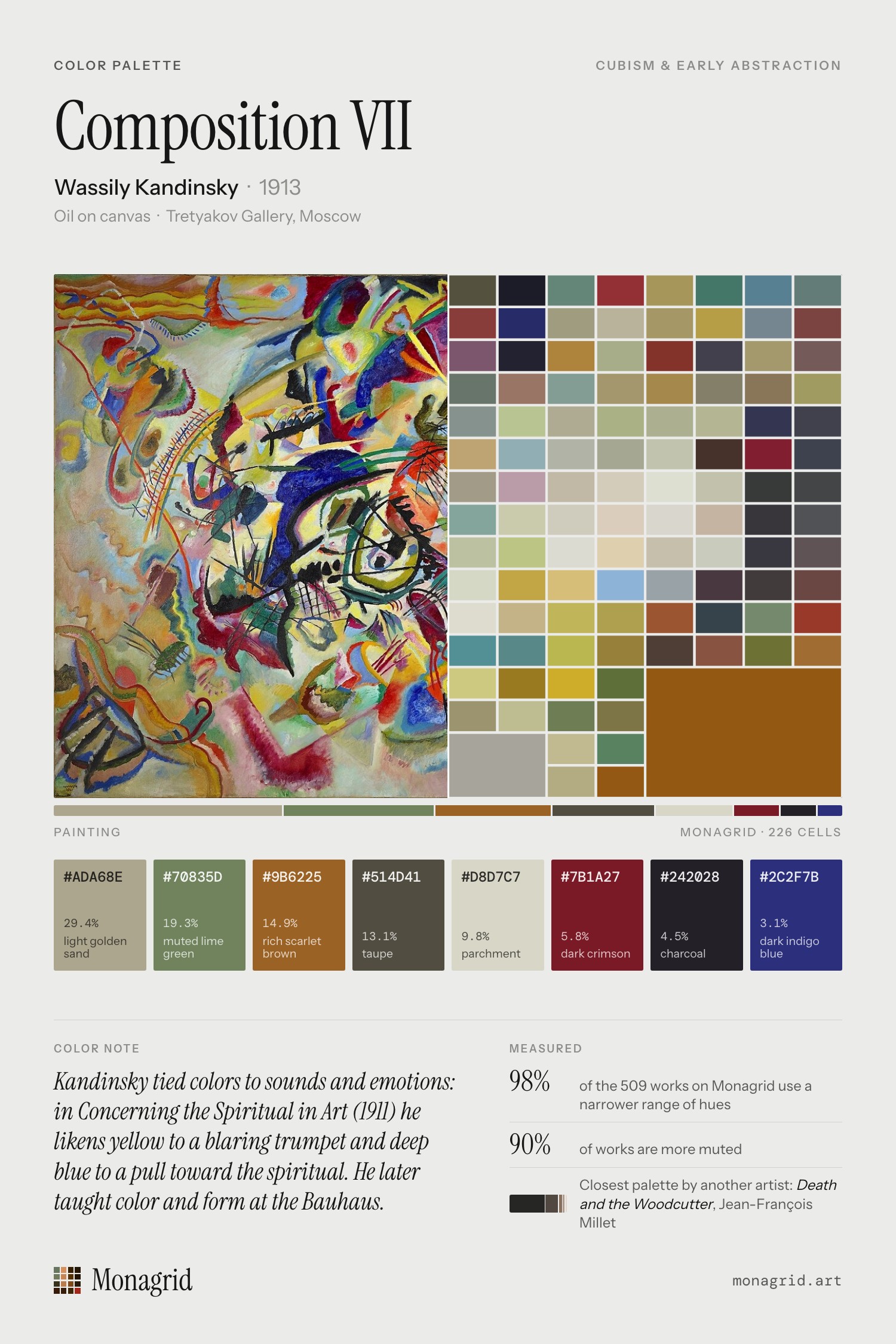
- #ada68e MG 190 light golden sand 29.4% of canvas
- #70835d MG 057 muted lime green 19.3% of canvas
- #9b6225 MG 161 rich scarlet brown 14.9% of canvas
- #514d41 MG 176 taupe 13.1% of canvas
- #d8d7c7 MG 201 parchment 9.8% of canvas
- #7b1a27 MG 008 dark crimson 5.8% of canvas
- #242028 MG 222 charcoal 4.5% of canvas
- #2c2f7b MG 113 dark indigo blue 3.1% of canvas
Color families
Brown 35%, Yellow 15%, Blue 12%, Gray 11%, Red 10%
Measurements
Composition
51% of the visual weight is in the right half, 50% in the lower half. Symmetry 0.11 (how closely its shapes and edges mirror each other). 3% of the canvas is calm space. Half of the detail sits in 35% of the canvas. Measured from the image, not a rule the painter followed.
Details
Share
Download the pin · Save to Pinterest

More by Wassily Kandinsky
- The Blue Rider, 1903
- Composition VI, 1913
- On White II, 1923
- Yellow-Red-Blue, 1925