Italian Renaissance · 1500
Salvator Mundi
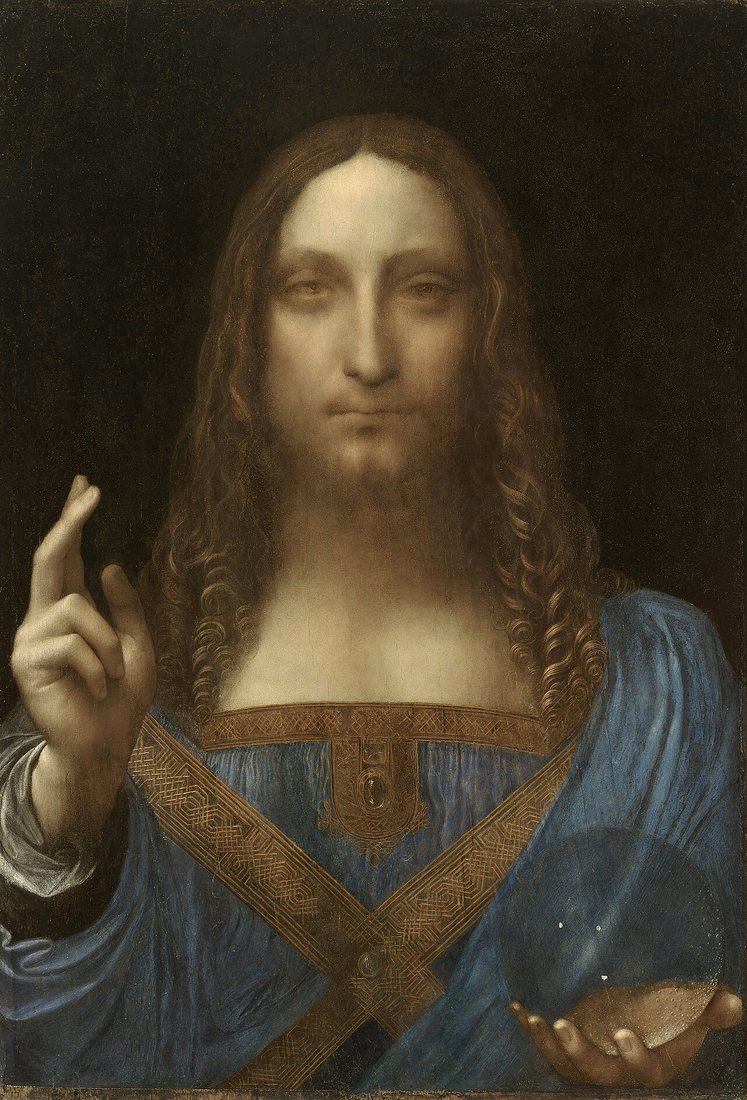
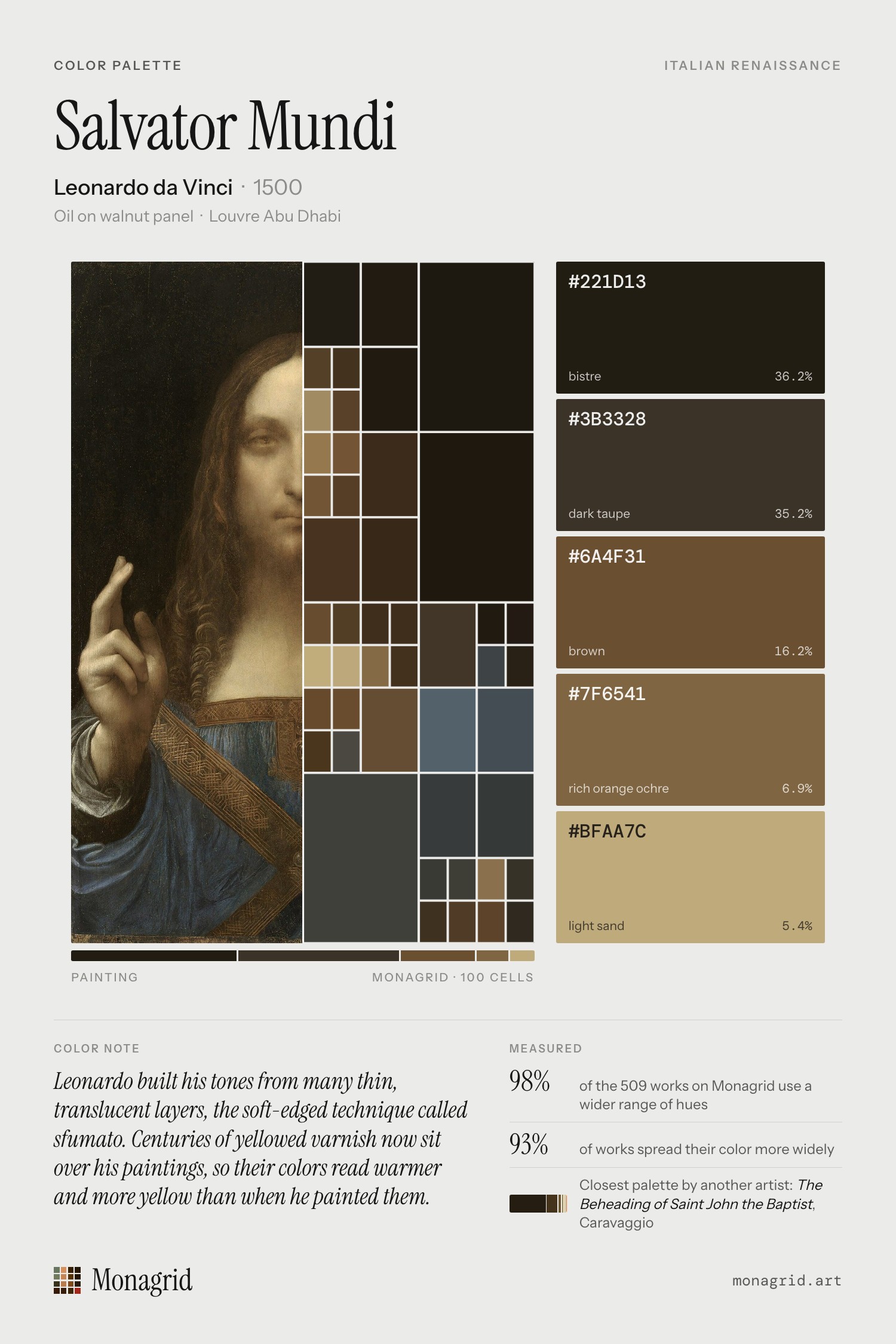
Salvator Mundi (1500) by Leonardo da Vinci. Its palette is led by bistre (#221d13, 36%) and dark taupe (#3b3328, 35%), with accents of light sand. Overall the canvas is dark, muted and warm.
Color note
Leonardo built his tones from many thin, translucent layers, the soft-edged technique called sfumato. Centuries of yellowed varnish now sit over his paintings, so their colors read warmer and more yellow than when he painted them.
Palette
- #221d13 MG 219 bistre 36.2% of canvas
- #3b3328 MG 177 dark taupe 35.2% of canvas
- #6a4f31 MG 167 brown 16.2% of canvas
- #7f6541 MG 178 rich orange ochre 6.9% of canvas
- #bfaa7c MG 181 light sand 5.4% of canvas
Color families
Brown 49%, Black 30%, Gray 18%, Yellow 2%, Blue 0%
Measurements
Composition
52% of the visual weight is in the left half, 62% in the lower half. Symmetry 0.68 (how closely its shapes and edges mirror each other). 52% of the canvas is calm space. Half of the detail sits in 26% of the canvas. Measured from the image, not a rule the painter followed.
Details
Share
Download the pin · Save to Pinterest

More by Leonardo da Vinci
- Ginevra de' Benci, c. 1476
- Lady with an Ermine, 1490
- The Last Supper, 1490s
- Mona Lisa, c. 1503